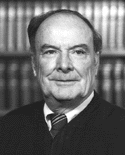
James Skelly Wright
(1911-1988)
(Courtesy: Harvard Law School Forum)
|
Judge James Skelly Wright was born on January 14, 1911 in New Orleans and educated there. He received his J.D. degree from Loyola University School of Law in 1934, and served as Judge of U.S. District Court for the Eastern District of Louisiana from 1949 to 1962 [1].
Judge Wright's service in New Orleans was terminated April 15, 1962, when he was commissioned to serve on the U.S. Court of Appeals for the District of Columbia. Prior to his reassignment, he had been instrumental in enforcing the desegregation of public facilities in New Orleans, including the Orleans Parish public schools, which incurred the wrath of uptown society, the business community, and the then powerful White Citizens' Council of New Orleans [2].
Lolis Elie, a leading black lawyer, said: "The only man I know who stood hard and fast for change was Judge Skelly Wright, the federal judge. He was forcing the city to face the reality of having to integrate the school system." After the first day of school desegregation, Wright's effigy was hung from a post outside a high school [2].
One of Wright's last acts was his attempt to desegregate Tulane University in 1962, which ultimately was foiled by a newly-appointed conservative judge friendly to Tulane. By then, the hostility toward Wright and his wife by uptown society had made life in New Orleans intolerable. His appointment by President John Kennedy to the Federal Appeals Court in Washington, D.C. enabled Wright and his family to leave the city with dignity [2,3].
Southern scholar, Adam Fairclough, wrote: “As for Skelly Wright, some believe that his Tulane judgment, as much as his schools decisions, made his position in New Orleans untenable. With Louisiana's senators blocking his advancement to the Fifth Circuit, he was elevated to the federal appeals court in Washington, D.C. He left New Orleans bitter at the abuse and social ostracism that he, his wife, and his son had suffered. "I'll never set foot in that town again to do anything public," he told Albert Dent [president of Dillard University], "unless those sons-of-bitches that ran me out of New Orleans invite me back."” [4] They never did, and in some quarters the racial and class distinctions that characterized the antebellum South persist to this day in covert form.
|
“In May 1960, Judge Wright issued the first order ever in Fifth Circuit territory setting a day certain for the beginning of grade school desegregation. His signature on that order and earlier rulings, all of them stridently opposed by strong forces in this State and City, put his personal safety at risk. Opposition to the Judge's day-certain order, his secretary recalled, had reached fever-pitch. One evening, when Judge Wright and his wife were out, a caller from the White Citizens Council rang. (Though the phone number was unlisted, it was found out.) The Wrights' son, James, then age thirteen, answered. "Let me speak to that dirty nigger-loving Communist," the voice demanded. Son James replied: "He's not at home. May I take a message?" Sheltered by loving parents through all the vilification and ostracism the Wrights endured, their young son simply took it in stride, along with the cross burned on the lawn and the company of U. S. marshals around the clock.” [5]
-- Ruth Bader Ginsburg, Associate Justice
United States Supreme Court
|
Bibliography
- "Judges of the United States Courts," Federal Judicial Center (http://air.fjc.gov/history/judges_frm.html) accessed September 19, 2002.
- "Study Guide to A House Divided," The Southern Institute for Education and Research (http://www.tulane.edu/~so-inst/divided15.html) accessed September 19, 2002. See note at 7, infra.
- "Study Guide to A House Divided," The Southern Institute for Education and Research (http://www.tulane.edu/~so-inst/divided25.html) accessed September 19, 2002. See note at 7, infra.
- Adam Fairclough, Race and Democracy: The Civil Rights Struggle in Louisiana, 1915 – 1972, University of Georgia Press, Athens, GA, 1995, p. 263 and reference to Albert Dent's interview, p. 526.
- Ruth Bader Ginsberg, Four Louisiana Giants in the Law, Judge Robert A. Ainsworth, Jr., Memorial Lecture, February 4, 2002, Loyola University New Orleans School of Law, http://www.supremecourtus.gov/publicinfo/speeches/sp_02-04-02.html, accessed 02/07/09.
- Kim Lacy Rogers, Righteous Lives: Narratives of the New Orleans Civil Rights Movement, New York University Press, 1994, 254 pp.
- Note: A House Divided is a documentary film by Burwell Ware that was produced by Xavier University Vice President Sybil Morial at its Drexel Center, New Orleans, in 1987. It deals with desegregation in New Orleans through the eyes of those who remember it. The study guide, A House Divided: A Teaching Guide on the History of Civil Rights in Louisiana, was authored by Plater Robinson of the Southern Institute for Education and Research at Tulane University, New Orleans, in 1995-96 and is available in print (114 pp.) as well as from the Internet (See 2 & 3, supra).
- Connie L. Cartledge, J. Skelly Wright: A Register of His Papers in the Library of Congress, Manuscript Division, Library of Congress, Washington, D.C., 2003, http://www.loc.gov/rr/mss/text/wrightjs.html, accessed 02/07/09.
- Liva Baker, The Second Battle of New Orleans: The Hundred-Year Struggle to Integrate the Schools, HarperCollins, New York, 1996, 564 pp., Esp. Chapt. 5, "Just Another Southern Boy."
- Jack Bass, Unlikely Heroes, Simon and Schuster, New York, 1981, 352 pp., Esp. Chapt. 7, "Skelly Wright and New Orleans," and Chapt. 8, "The Pursuit of Justice."
- Morton Inger, Politics and Reality in an American City: The New Orleans School Crisis of 1960 [Monograph] Center for Urban Education, New York, 1969, 114 pp.
|